Numerical Methods Projects
Fall 2020
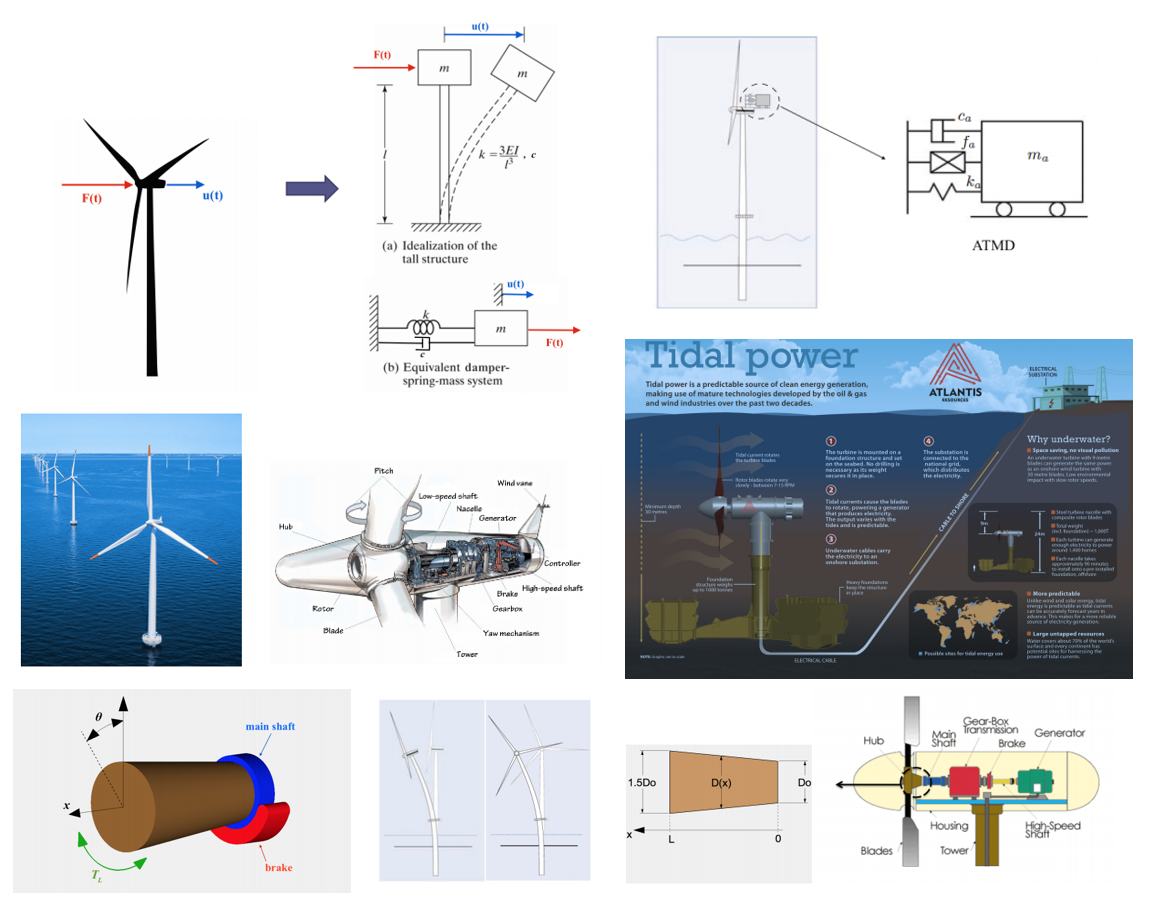
In my Numerical Methods course, we engaged in four different "Computing Projects" (CPs), each covering a different type of numerical method. Each project consisted of a real-world situation, a description of relevant mathematical models, and a set of tasks to complete. All the CPs involved writing MATLAB functions and scripts to solve said situations, and some CPs—namely CP1 and CP3—required a report analyzing and demonstrating the results. Below are brief descriptions of each CP along with links to the supporting files.
CP1: Curve Fitting Techniques
For this CP, I was tasked with analyzing the efficiency and vibration characteristics of an off-shore wind turbine. The object in question was a prototype Active Tuned Mass Damper (ATMD). The goal was to calculate pertinent values about the ATMD by implementing different curve-fitting techniques in MATLAB.
CP2: Root-finding & Numerical Integration
This CP focused on analyzing the efficiency of tidal energy generators. Given a few characteristics of the system, such as the blade diameter, mechanical efficiency, and experimental velocity data, I had to calculate the power coefficient. This was accomplished by implementing root-finding and numerical integration techniques in MATLAB.
CP3: Ordinary Differential Equations
Initial Value Problems
In this CP, I was once again tasked with analyzing the vibration characteristics of a wind turbine, but this time with a different approach and goal. The goal was to study the vibration of the turbine in response to external forces using a simple, single-degree of freedom system, modelled by a 2nd order ODE. Given some starting values, I had to implement various Runge-Kutta Methods as well as MATLAB's built-in functions to accurately predict the vibration of the system over time.
CP4: Ordinary Differential Equations
Boundary Value Problems
For the final CP, I was tasked with determining whether or not the material of the main shaft of a wind turbine could be modified for cost-effectiveness. Given specific characteristics of the system, I had to perform a torsion-vibration analysis utilizing the same concepts as CP3, but with a boundary value problem instead. Included in this CP was a handwritten section, which clearly outlines the steps taken to solve the given system.
These projects required me to think "out of the box," as they often had limitations on things like how many for-loops one could utilize, and they introduced real-world scenarios that were beyond my scope of prior knowledge. As a result, I managed to learn a significant amount and apply the skills I had learned both in previous courses as well as this one. As a final note, I received high marks on all of my CPs.